Skip to Content

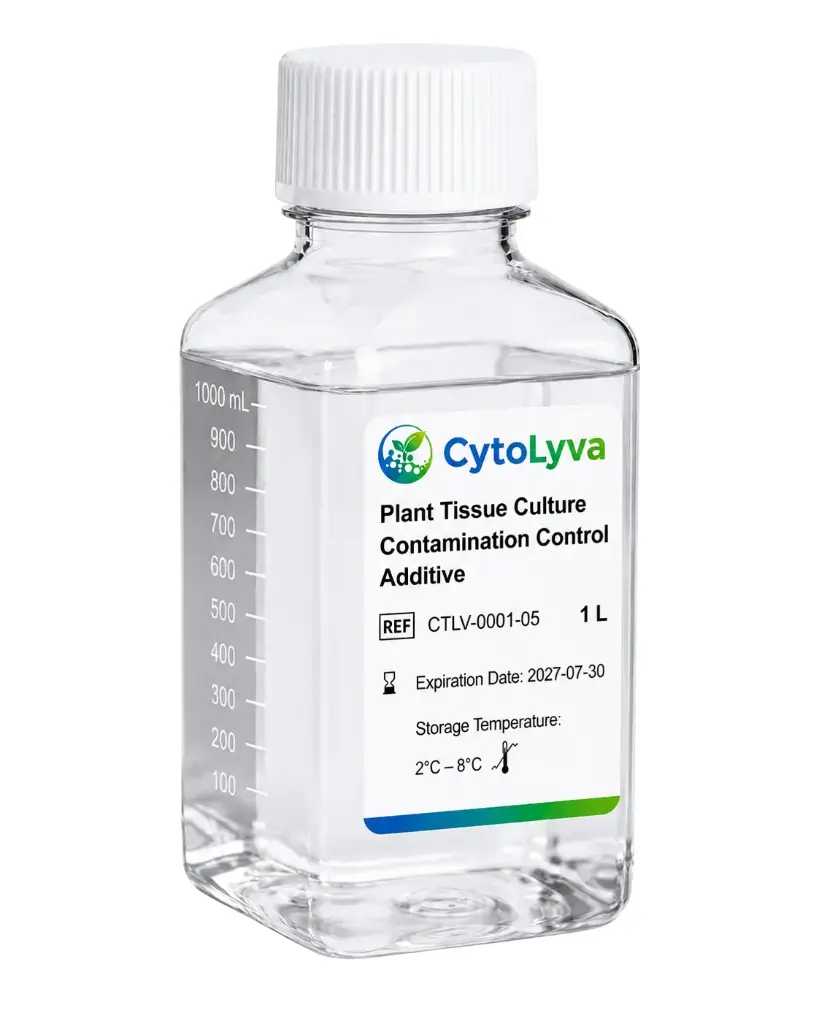
Plant Tissue Culture Contamination Control Additive

https://www.cytolyva.com/web/image/product.template/1099235/image_1920?unique=085af0d

REF: CTLV-0001-05
Size: 1 L

£ 1,013.02 1013.02 GBP £ 1,013.02

1,013.02 €

Not Available For Sale

This combination does not exist.

Overview


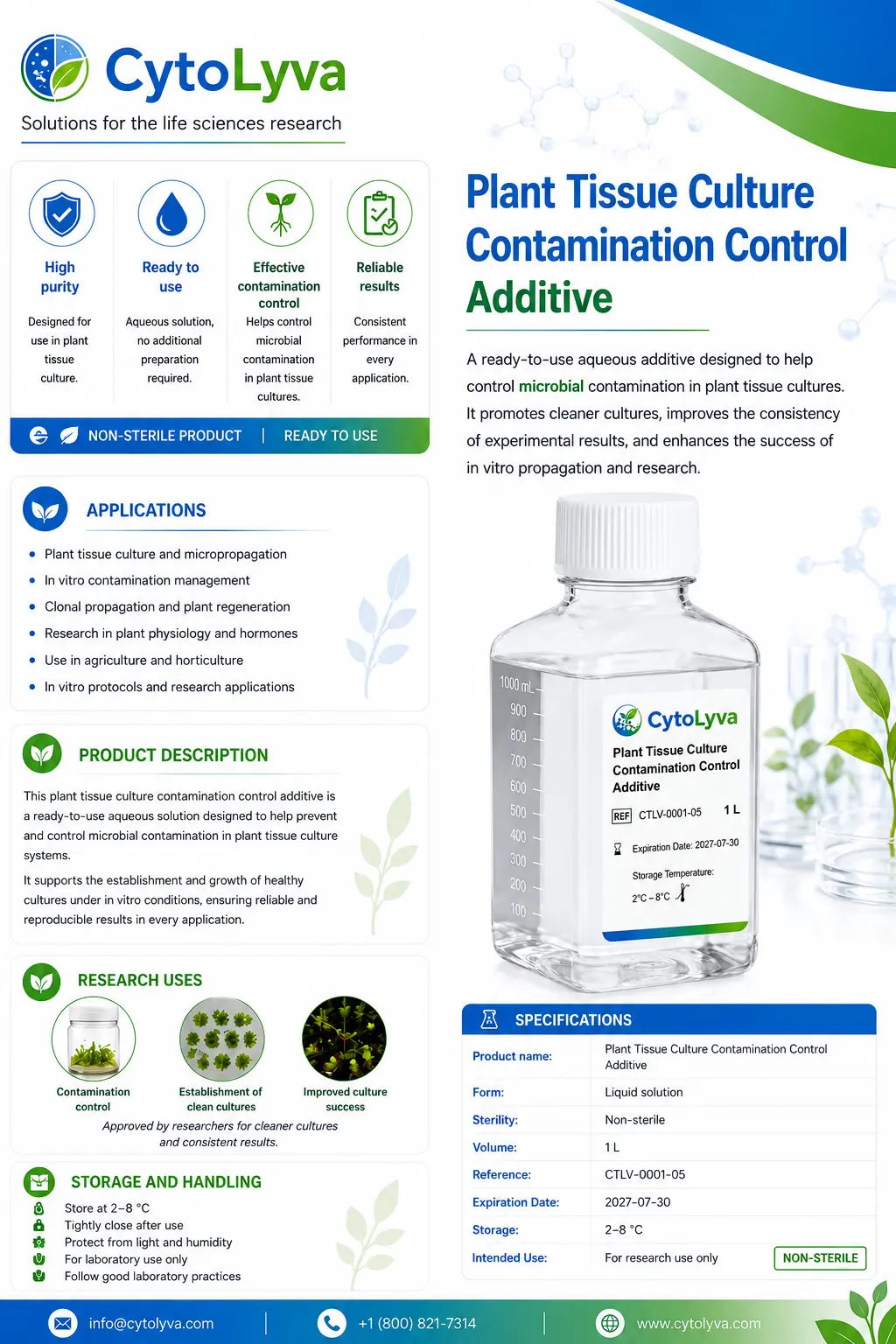
Plant Tissue Culture Contamination Control Additive is a laboratory media supplement designed to support the establishment and maintenance of in-vitro plant tissue culture systems.


During plant micropropagation workflows, contamination originating from explants, handling, or environmental exposure can disrupt culture development. When incorporated into culture media, this additive helps maintain stable culture conditions and supports successful plant tissue culture establishment.


The reagent is suitable for use in solid or liquid plant culture media and is compatible with most standard plant tissue culture formulations used in research laboratories and micropropagation facilities.


This product is intended exclusively for laboratory plant tissue culture applications.

Key Features


  • Supports stable conditions in plant tissue culture systems
  • Compatible with most standard plant culture media formulations
  • Effective at low working concentrations
  • Suitable for both solid and liquid culture media
  • Compatible with standard media preparation workflows
  • Useful when working with challenging explant material

Applications


Plant Micropropagation

Supports stable culture conditions during shoot multiplication and rooting stages in plant tissue culture systems.


Explant Establishment

Facilitates the establishment of cultures from plant material collected from greenhouse or field environments.


Callus Culture

Suitable for callus induction experiments where consistent culture conditions are important for successful tissue development.


Plant Regeneration Studies

Applicable in plant regeneration protocols involving organogenesis or somatic embryogenesis.


Plant Biotechnology Research

Useful in plant transformation workflows and other experimental procedures involving plant tissue culture.

Compatible Culture Media


The additive can be used with most commonly employed plant tissue culture formulations, including:


  • Murashige & Skoog (MS) medium
  • Gamborg B5 medium
  • Woody Plant Medium (WPM)
  • Chu N6 medium
  • Custom plant tissue culture media​

Recommended Usage


The additive is typically used at low concentrations during plant tissue culture media preparation.

Culture Stage

Suggested Concentration

Explant establishment

0.1–0.2 % (v/v)

Routine micropropagation

0.05–0.1 % (v/v)

Sensitive plant material

optimize experimentally​

Optimal concentrations may vary depending on plant species, explant source, and laboratory conditions.

General Protocol


1. Prepare Culture Medium

Prepare the plant tissue culture medium according to the desired formulation.


2. Add the Additive

Add the Plant Tissue Culture Contamination Control Additive to the medium at the desired final concentration.


3. Mix Thoroughly

Mix the medium to ensure even distribution of the additive.


4. Sterilization

Sterilize the medium according to standard laboratory procedures appropriate for the selected medium formulation.


5. Dispense Medium

Pour the prepared medium into sterile culture vessels.


6. Introduce Plant Material

Transfer plant explants to the prepared medium using standard sterile tissue culture techniques.

Tips for Best Results


  • Perform small-scale tests when working with new plant species.
  • Combine proper explant surface sterilization with appropriate culture practices.
  • Adjust additive concentration depending on plant species and culture conditions.

Storage and Stability


  •  Store according to the conditions indicated on the product label.
  • Avoid repeated contamination of the stock solution during routine laboratory use.

Intended Use


  • For research and laboratory plant tissue culture use only.
  • Not intended for agricultural field use, environmental applications, or crop protection purposes.

  Murashige & Skoog Basal Salts With FeNaEDTA, Macronutrients and Micronutrients

Complete powdered basal medium for plant tissue culture, micropropagation and plant research applications.

CytoLyva's Murashige & Skoog Basal Salts With FeNaEDTA, Macronutrients and Micronutrients is a complete powdered plant tissue culture formulation designed for laboratories involved in plant cell culture, tissue culture, micropropagation, regeneration and plant physiology research.

This formulation contains the essential macronutrients, micronutrients and FeNaEDTA (iron source) required for the in vitro cultivation of a wide variety of plant species. Each bottle contains 44.30 g of powder, sufficient to prepare 10 litres of basal medium when reconstituted according to the appropriate laboratory protocol.

Product Overview


Murashige & Skoog (MS) medium is one of the most widely used basal media in plant tissue culture. This formulation provides a balanced combination of macronutrients, micronutrients and FeNaEDTA to support the in vitro growth and development of numerous plant species.

The powdered format allows researchers to prepare fresh culture medium while maintaining flexibility to modify the final composition according to the plant species, tissue type and experimental requirements.

Depending on the intended application, the prepared medium may be supplemented with:

  • Sucrose
  • Agar or other gelling agents
  • Plant growth regulators (auxins and cytokinins)
  • Antibiotics
  • Activated charcoal
  • Other laboratory supplements

Applications


CytoLyva Murashige & Skoog Basal Salts With FeNaEDTA, Macronutrients and Micronutrients may be used in:

  • Plant tissue culture
  • Plant cell culture
  • Micropropagation
  • In vitro seed germination
  • Callus induction and maintenance
  • Shoot induction and multiplication
  • Root induction
  • Plant regeneration
  • Culture of explants, meristems and plant organs
  • Plant physiology studies
  • Agricultural and horticultural research
  • Botanical research
  • Preparation of customized plant culture media

Product Description


Murashige & Skoog basal medium provides essential mineral nutrients required for the controlled in vitro cultivation of plant tissues, cells and organs.

This formulation combines MS basal salts with FeNaEDTA, providing a convenient powdered medium for laboratory preparation.

The formulation includes:

  • Macronutrients required in relatively large quantities for plant growth
  • Micronutrients supplying essential trace elements
  • FeNaEDTA providing a stable iron source required for plant development and cellular metabolism

The final performance of the prepared medium depends on several experimental variables, including:

  • Plant species
  • Explant type
  • Culture conditions
  • Medium pH
  • Added plant growth regulators
  • Carbon source
  • Additional supplements

Researchers can adapt the basal formulation according to their own experimental protocols.

CytoLyva's powdered formulation provides a convenient and reproducible solution for laboratories routinely preparing MS-based plant culture media.

Preparation Guidance


Dissolve the complete contents of one 44.30 g bottle in purified or distilled water to prepare a final volume of 10 litres.

The preparation procedure may vary according to laboratory protocols. Researchers may need to:

  • Dissolve the powder in approximately 80–90% of the required final water volume.
  • Add sucrose if required.
  • Supplement with plant growth regulators or other additives.
  • Adjust the pH according to the selected protocol.
  • Add a suitable gelling agent when preparing solid media.
  • Bring the solution to the final volume of 10 L.
  • Sterilize or filter the prepared medium according to the requirements of the added components and experimental procedure.

The optimal supplementation, pH and sterilization conditions should always be validated for the intended plant species and application.

Storage and Handling


Store the unopened product according to the conditions indicated on the product label or accompanying technical documentation.

Keep the bottle tightly sealed and protect the powder from:

  • Moisture
  • Excessive heat
  • Direct sunlight

Allow the container to reach room temperature before opening when necessary to minimize condensation.

Handle the product using appropriate laboratory procedures, personal protective equipment and good laboratory practice.

​ Specifications


Product Name: Murashige & Skoog Basal Salts With FeNaEDTA, Macronutrients and Micronutrients

Reference: CTLV-0145-02

Form: Powder

Composition: FeNaEDTA, Macronutrients and Micronutrients

Pack Size: 1 Bottle

Net Weight: 44.30 g

Preparation Volume: 10 L

Application: Plant tissue culture and plant research

Intended Use: Research Use Only

​ Suggested Use


Murashige & Skoog Basal Salts With FeNaEDTA, Macronutrients and Micronutrients serve as the nutritional foundation for numerous plant tissue culture applications.

The basal formulation may be customized through the addition of plant growth regulators and other supplements depending on the desired application, including:

  • Callus induction
  • Shoot multiplication
  • Rooting
  • Plant regeneration
  • Organogenesis
  • Somatic embryogenesis

The optimal medium composition depends on:

  • Plant species
  • Cultivar
  • Explant type
  • Developmental stage
  • Growth regulator combination
  • Culture temperature
  • Light conditions
  • Liquid or solid culture system
  • Experimental objectives

Researchers should optimize the final formulation for their specific experimental system.

​ Why Choose CytoLyva Murashige & Skoog Basal Salts?


CytoLyva provides high-quality plant tissue culture reagents designed for reliable laboratory performance and consistent medium preparation.

This Murashige & Skoog Basal Salts With FeNaEDTA, Macronutrients and Micronutrients formulation combines essential mineral nutrients and FeNaEDTA in a convenient pre-weighed 44.30 g bottle, sufficient to prepare 10 litres of culture  medium.

Its powdered format allows laboratories to prepare fresh media while maintaining flexibility to optimize formulations for plant tissue culture, micropropagation, regeneration, plant physiology and other plant research applications.