Skip to Content

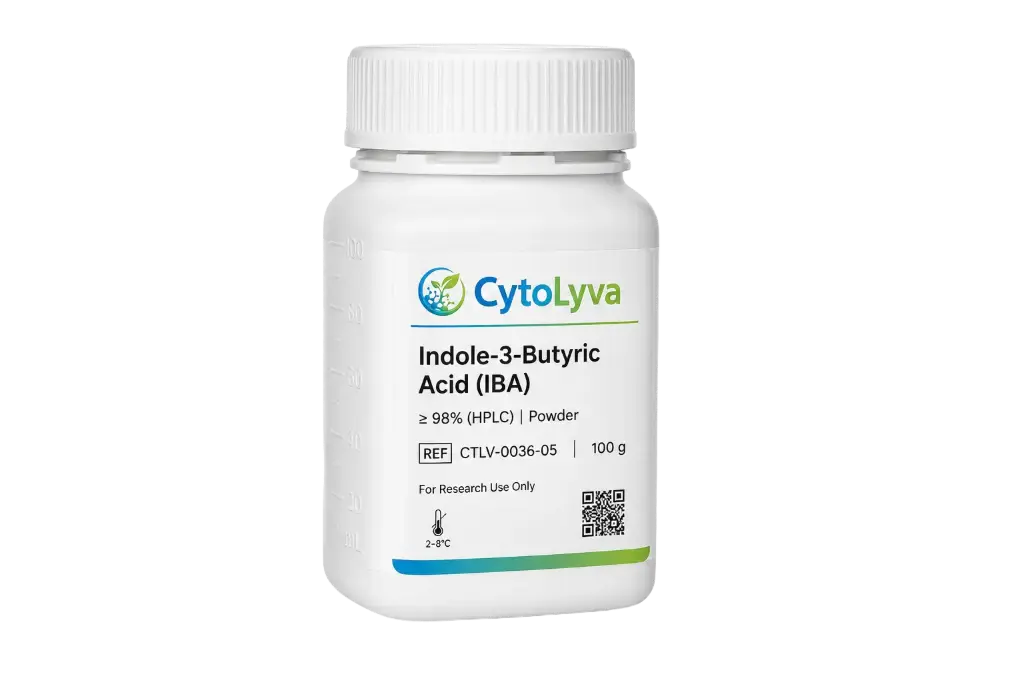
Indole-3-Butyric Acid (IBA)

https://www.cytolyva.com/web/image/product.template/1099180/image_1920?unique=0e48854

REF: CTLV-0036-05
Size: 100 g

£ 227.46 227.46 GBP £ 227.46

227.46 €

Not Available For Sale

This combination does not exist.

Indole-3-Butyric Acid (IBA) Powder


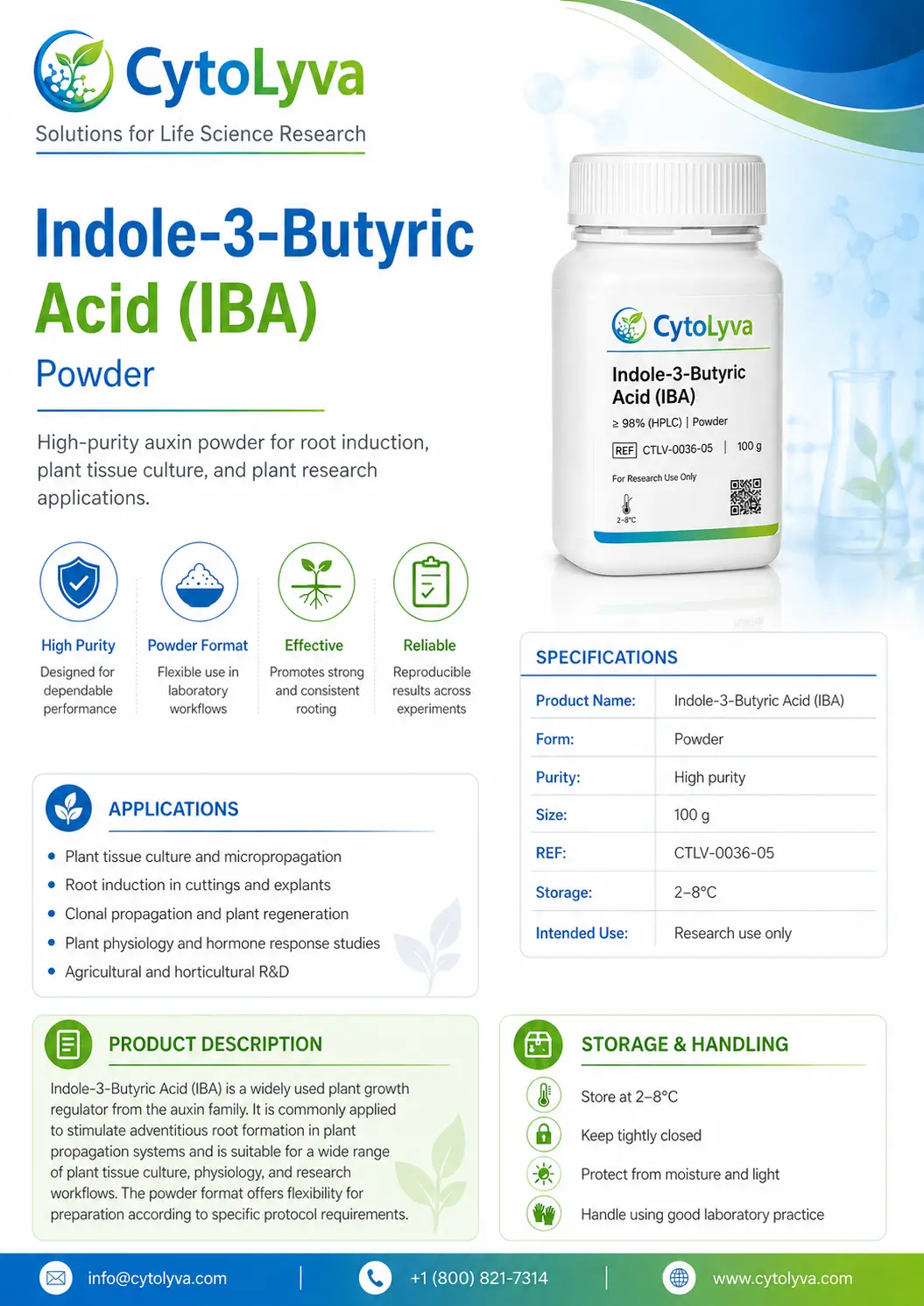
High-purity auxin powder for root induction, plant tissue culture, and plant research applications.

CytoLyva’s Indole-3-Butyric Acid (IBA) Powder is a high-quality plant growth regulator designed for research laboratories working with plant propagation, tissue culture, micropropagation, and root induction protocols. Supplied in a flexible powder format, this product allows researchers to prepare solutions according to their specific experimental needs.

Product Overview


Indole-3-Butyric Acid, commonly known as IBA, is a synthetic auxin widely used in plant science research to promote adventitious root formation. It is frequently applied in plant tissue culture, clonal propagation, horticultural research, and plant physiology studies.

This non-sterile powder format is suitable for laboratories that require flexibility in concentration, solvent choice, and protocol adaptation. It is intended for research use only and is not supplied as a ready-to-use sterile solution.

Key Benefits


High-Purity Auxin Powder
Designed for reliable laboratory performance and reproducible plant research workflows.

Flexible Powder Format
Allows preparation of custom stock solutions and working concentrations according to protocol requirements.

Supports Root Induction
Commonly used to stimulate root development in cuttings, explants, and plant tissue culture systems.

Suitable for Plant Research
Applicable in micropropagation, hormone response studies, plant physiology, and agricultural R&D.

Research Use Only
Developed for laboratory and research applications.


Applications


CytoLyva Indole-3-Butyric Acid (IBA) Powder may be used in:

  • Plant tissue culture and micropropagation
  • Root induction in cuttings and explants
  • Clonal propagation research
  • Plant regeneration workflows
  • Plant hormone response studies
  • Agricultural, horticultural, and botanical research
  • Preparation of auxin stock solutions for experimental protocols 

Product Description


Indole-3-Butyric Acid is a plant growth regulator from the auxin family. Auxins play an important role in plant development, including cell elongation, differentiation, root initiation, and tissue response.

IBA is especially valued in research protocols requiring controlled root induction. Compared with ready-to-use liquid formulations, the powder format gives laboratories more flexibility for preparing concentrations tailored to different plant species, tissue types, and experimental designs.

CytoLyva’s IBA Powder is supplied for research use and should be handled according to good laboratory practice.


Specifications


Product Name: Indole-3-Butyric Acid (IBA)

Form: Powder

Purity: ≥ 98% HPLC

Size: 100 g

Reference: CTLV-0036-05

Storage: 2–8°C

Sterility: Non-sterile

Intended Use: Research use only

Storage & Handling


Store Indole-3-Butyric Acid (IBA) Powder at 2–8°C. Keep the container tightly closed and protect from moisture and light. Allow the product to reach room temperature before opening when needed, to reduce condensation risk.

Handle using standard laboratory safety procedures, including appropriate protective equipment and good laboratory practice.

Suggested Use


IBA powder is commonly used to prepare stock solutions or working solutions for plant tissue culture and root induction experiments. The optimal concentration and preparation method may vary depending on the plant species, tissue type, solvent system, and research protocol.

Researchers should validate the appropriate concentration and application method for their specific experimental conditions.

Why Choose CytoLyva IBA Powder?


CytoLyva provides research reagents designed for consistency, clarity, and ease of use in life science workflows. This IBA powder format is ideal for laboratories that require a high-purity auxin reagent with flexible preparation options for plant propagation and tissue culture research.

Murashige & Skoog Basal Salts with Macronutrients, Micronutrients, Vitamins and Glycine  

Complete powdered basal medium for plant tissue culture, micropropagation and plant research applications.

CytoLyva’s Murashige & Skoog Basal Salts with Macronutrients, Micronutrients, Vitamins and Glycine is a complete powdered plant tissue culture medium designed for laboratories working with plant cell culture, tissue culture, micropropagation, regeneration and plant physiology research.

The formulation contains the essential mineral salts, vitamins and glycine commonly required to support plant tissue growth under controlled laboratory conditions. Each pouch contains 221.30 g of powder, sufficient to prepare 50 litres of basal medium when reconstituted according to the appropriate laboratory protocol.

Product Overview


Murashige & Skoog medium, commonly referred to as MS medium, is one of the most widely used basal media in plant tissue culture. It provides a balanced combination of macronutrients, micronutrients, vitamins and glycine to support the in vitro growth and development of a broad range of plant species.

This powdered formulation allows researchers to prepare fresh culture medium and adapt the final composition according to the requirements of the plant species, tissue type and experimental protocol.

Depending on the application, researchers may supplement the prepared medium with sucrose, agar or another gelling agent, plant growth regulators, antibiotics or other experimental additives.

Applications


CytoLyva Murashige & Skoog Basal Salts may be used in:

  • Plant tissue culture
  • Plant cell culture
  • Micropropagation
  • In vitro seed germination
  • Callus induction and maintenance
  • Shoot induction and multiplication
  • Root induction
  • Plant regeneration workflows
  • Culture of explants, meristems and plant organs
  • Plant physiology and developmental studies
  • Agricultural, horticultural and botanical research
  • Preparation of customized plant culture media

Product Description


Murashige & Skoog basal medium provides essential inorganic nutrients and vitamins required for the controlled in vitro cultivation of plant cells, tissues and organs.

The macronutrient components supply elements required in relatively large quantities for plant growth, while the micronutrients provide essential trace elements. The included vitamins and glycine support cellular metabolism and tissue development under laboratory culture conditions.

The final performance of the prepared medium may depend on the plant species, explant type, pH, culture conditions and additional supplements used. Researchers can modify the basal medium by adding plant growth regulators such as auxins or cytokinins, as well as sucrose, gelling agents or other compounds required for a specific experimental workflow.

CytoLyva’s powdered format offers a practical solution for laboratories that require consistent preparation of MS-based plant culture medium.

Specifications


  • Product Name: Murashige & Skoog Basal Salts with Macronutrients, Micronutrients, Vitamins and Glycine
  • Reference: CTLV-0139-04
  • Form: Powder
  • Composition: Macronutrients, micronutrients, vitamins and glycine
  • Pack Size:Pouch
  • Net Weight:221.30 g
  • Preparation Volume: 50 L
  • Application: Plant tissue culture and plant research
  • Intended Use: Research use only

Preparation Guidance


Dissolve the complete contents of one 221.30 g pouch in purified or distilled water to prepare a final volume of 50 litres.

The exact preparation procedure may vary according to the laboratory protocol. Researchers may need to:

  1. Dissolve the powder in approximately 80–90% of the required final water volume.
  2. Add sucrose, plant growth regulators or other supplements as required.
  3. Adjust the pH according to the selected plant tissue culture protocol.
  4. Add a suitable gelling agent when preparing solid medium.
  5. Bring the solution to the final volume of 50 L.
  6. Sterilize or filter the prepared medium according to the requirements of the added components and experimental procedure.

The optimal supplementation, pH and sterilization conditions should be validated for the specific plant species and tissue culture application.

Storage and Handling


Store the unopened product according to the conditions indicated on the product label or accompanying technical documentation.

Keep the bottle tightly closed and protect the powder from moisture, excessive heat and direct light. Allow the container to reach room temperature before opening when necessary to help reduce the risk of condensation.

Handle the product using standard laboratory procedures, appropriate personal protective equipment and good laboratory practice.

​ Suggested Use


Murashige & Skoog Basal Salts are commonly used as the nutritional foundation for plant tissue culture media. The basal formulation can be adapted by adding appropriate plant growth regulators and supplements according to the required response, such as callus induction, shoot multiplication, rooting or plant regeneration.

The optimal medium composition may vary depending on:

  • Plant species and cultivar
  • Explant or tissue type
  • Developmental stage
  • Plant growth regulator combination
  • Culture temperature and lighting
  • Liquid or solid culture format
  • Experimental objectives

Researchers should validate the final formulation and culture conditions for their specific experimental system.

​ Why Choose CytoLyva Murashige & Skoog Basal Salts?


CytoLyva provides plant research reagents designed for consistency, convenient preparation and reliable integration into laboratory workflows.

This MS basal salts formulation combines macronutrients, micronutrients, vitamins and glycine in one pre-weighed pouch. With 221.30 g sufficient for preparing 50 litres, it offers a practical solution for laboratories performing plant tissue culture, micropropagation, regeneration and plant physiology research.